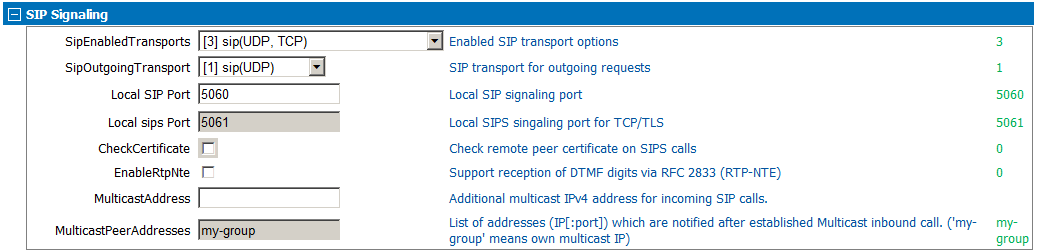
SIP Signaling Tab
- SipEnabledTransports
-
Defines which transports are enabled. Any combination of the following transports is supported:
- sip(UDP) - non-secured SIP via UDP
- sip(TCP) - non-secured SIP via TCP
- sip(TCP) - non-secured SIP via TCP
FoIP accepts incoming requests from any enabled transport. If Sips is selected, an SSL certificate must be configured in the SSL section (as it is with TWS, Message Connector)
- SipOutgoingTranport
- Defines the transport used to outgoing requests. The selected transport must be enabled.
- Local SIP Port
- Defines the local SIP signaling port for UDP and TCP.
- Local sips Port
- Defines the local SIP signaling port for TCP/TLS.
- CheckCertificate
- If enabled, SIP via TCP/TSL from remote side must have a valid SSL certificate/key according to the SSL Certificate configuration to prevent a man-in-the-middle attack.
- EnableRtpNte
- Enables reception of DTMF digits via RTP named-telephone-events according to RFC 2833. This function is required if a Voice integration via SIP is used in order the allow DTMF input. It is disabled by default because it may cause compatibility problems (even with fax calls) if the IP system does not support RFC 2833.
- MulticastAddress
- You can optionally specify an IPv4 multicast address. Reception via multicast address can be used for failover and load balancing installations. IPv6 support is disabled if a multicast address is specified.
- MulticastPeerAddresses
- Blank separated list of addresses (IP[:port]) that are notified after established multicast inbound call. The special
value
my-group
means own multicast IP.